An independent buyer’s guide
Inside Vispring’s Pocket-Spring Craftsmanship: What Buyers Should Know
A mattress can be described in inches, layers, and spring counts. Sleeping on one is a less tidy business. Vispring’s beds invite close attention to their pocket-spring construction, upholstery, and hand-finishing—but buyers are best served by looking past the language of luxury and asking how those details might suit the way they actually sleep.
There is a particular seriousness to a bed made by hand. It suggests a patient sequence of choices: material selected, layer placed, edge finished, spring enclosed. In a market where mattresses are often presented as bundles of features, such craft can seem almost old-fashioned. Yet the useful question is not whether a mattress has an impressive story. It is what its construction does beneath a sleeper’s shoulder at two in the morning, or whether its surface still feels appropriate after years of use.
Vispring is known for beds built around pocket springs and carefully selected upholstery materials. The name may carry associations with traditional British bedmaking and a high-end price point, but neither tradition nor price can determine whether a particular model is right for a particular person. The construction deserves a closer look, as do the practical matters that may be less romantic: firmness, bed-base compatibility, care, delivery, and the terms of a warranty.
This guide explains how to examine those details. It does not attempt to declare one model universally comfortable, or to turn craftsmanship into a guarantee of better sleep. Instead, it offers a way to compare a Vispring bed with other options: by understanding what pocket springs do, asking what lies above them, and judging the whole assembly against your own preferences and household needs.
What a pocket spring actually does
A pocket spring is an individual coil enclosed in a fabric pocket. In a mattress, many such springs work together beneath the upholstery. Because each spring can respond separately to pressure, the surface may adjust more locally than a design in which coils are joined into a single interconnected unit. In practical terms, that can help a mattress respond differently beneath the hips, shoulders, and other parts of the body, rather than moving as one broad platform.
That description is a starting point, not a verdict. The feel of a finished bed depends on more than the presence of pockets. Spring design, wire characteristics, arrangement, upholstery, mattress tension, and the support underneath all contribute. Two pocket-spring beds can feel markedly different. Even the number of springs, often given prominent attention in product descriptions, does not by itself tell a buyer whether a mattress will feel comfortable or supportive.
Spring count is most useful when understood as one construction detail among several. Counts may be reported for different sizes, and manufacturers may count different spring units or layers. A larger number does not automatically mean better alignment, longer life, or a more suitable feel. Ask what the count refers to, how the springs are arranged, and how the upholstery changes the way that spring system is experienced.
It is also worth distinguishing support from surface comfort. A mattress may feel soft at first contact while still providing a more structured response beneath the padding. Conversely, a firm-feeling surface is not necessarily supportive for every body. The aim is not to choose the most elaborate spring system, but to find an overall construction that allows a comfortable, reasonably neutral sleeping position without creating pressure that repeatedly draws attention to itself.
The layers above the springs
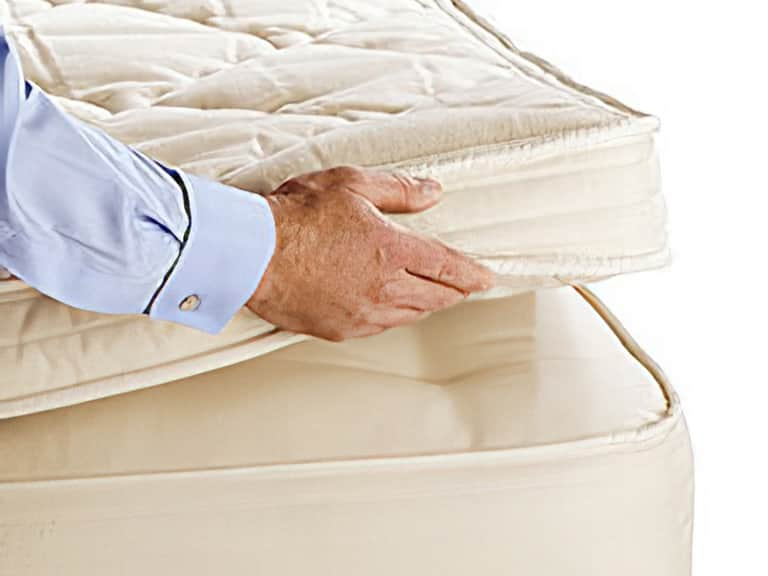
In a handcrafted bed, the upholstery is not merely decoration placed over the mechanism. It is part of the mechanism as the sleeper experiences it. Materials used above the springs affect cushioning, resilience, warmth, and the speed with which the surface settles and returns. Wool, cotton, hair, and other natural or blended fibers may appear in mattress upholstery, depending on the model and its specification. The presence of a named material is not enough to predict feel; buyers should learn where it sits, how much is used, and how the layers are assembled.
Natural fibers are often valued for their particular texture and capacity to handle moisture, but broad claims about “breathability” or “temperature control” need context. A person’s sense of temperature is affected by the room, bedding, pajamas, body, and mattress together. A wool layer may contribute to a different sleep climate from a dense foam layer, but it cannot guarantee that every sleeper will feel cool. Likewise, a luxurious-sounding fiber does not necessarily make the mattress more comfortable for someone who prefers a firmer, less cushioned surface.
Ask for a clear description of the upholstery stack. Which materials are used? Are they arranged in distinct layers or blended? Are they included in all versions of the model? Does the specification change with mattress size or firmness choice? These are not fussy questions. They help establish what you are paying for and make comparisons with other beds more meaningful.
There is also a difference between learning a material’s name and understanding its role. The same fiber can contribute cushioning in one construction and a more modest finishing layer in another. A product description that lists several prestigious materials but gives little information about their placement may leave the most important part of the story unwritten.
Handmade does not mean self-explanatory
Handmaking can refer to specific stages of construction, and its meaning is most useful when a manufacturer or retailer explains those stages plainly. It may involve assembling, stitching, securing, or finishing components by hand. The details vary, so buyers should avoid assuming that the phrase describes every part of production or that it predicts a particular comfort level.
Hand-finishing can matter to durability and consistency when it is well executed. It may also make some kinds of repair or adjustment more feasible, depending on the mattress design and service available. But there is no need to treat craftsmanship as a spell. A handmade label does not tell you whether the bed suits your body, whether the seller will provide dependable support after purchase, or whether the construction is a good value for your circumstances.
Ask what the maker means by handmade in the context of the model you are considering. Which elements are assembled or finished by hand? What parts of the construction are consistent across the range, and what changes between models? If a retailer cannot answer, that may be a reason to seek more detailed information before making a decision.
Good craftsmanship is often most persuasive when it is visible in a modest way: seams that appear secure, a cover that sits evenly, and a description of materials that is specific rather than inflated. The quality of a bed is not measured by ceremony. It is better assessed through its design, its finish, the clarity of its specification, and the experience of lying on it for long enough to make a considered judgment.
Firmness: a word with several meanings
Firmness is among the most requested mattress specifications and among the least universal. One retailer’s “medium” can feel different from another’s. Body weight, sleeping position, preferred surface, and the bed base all influence the experience. A person who sleeps on their side may be especially attentive to pressure around the shoulder and hip; a back sleeper may be more sensitive to whether the middle of the body feels adequately supported. These are useful starting points, not rigid rules.
When comparing Vispring models, ask the retailer to explain the available firmness options in relation to the construction, rather than relying only on a label. If possible, test more than one model and spend enough time in your usual sleeping position to notice whether pressure builds. A brief sit on the edge or a quick lie on your back is not a full assessment. Bring the pillow you normally use if practical, since pillow height can change the way your neck and shoulders feel on the mattress.
For couples, differing preferences complicate the decision. Ask whether a particular model or size can accommodate different comfort choices on each side, and request the details in writing. Do not assume that every model offers the same degree of customization. If a split-feel arrangement is available, consider whether the division between sides will be noticeable and how it affects the overall surface.
A showroom test is valuable, but it cannot reproduce a full night at home. Before ordering, understand the seller’s trial, exchange, or comfort-adjustment policies. Check the time period, any fees, eligibility conditions, and whether the mattress must be used with a specified base. Policies vary, and a verbal assurance is less useful than written terms.
Motion, edges, and the realities of sharing a bed
Pocket springs are often discussed in connection with motion isolation because individual springs can respond more independently than a fully interconnected coil system. In a finished mattress, however, motion behavior depends on the entire construction. Upholstery, spring arrangement, tension, and the sleeper’s movement all matter. A bed that reduces noticeable disturbance for one couple may not do so enough for another.
If one person is a light sleeper or the other moves frequently, test the mattress together when possible. One person can lie still while the other changes position, sits down, or gets out of bed. This is not a laboratory measurement; it is a practical comparison. Pay attention not only to movement across the surface but also to how the bed responds near the middle and edges.
Edge support is another property that should be tested rather than inferred from a premium price or a spring count. Sit where you usually dress, and lie near the side of the bed. Notice whether the edge feels stable enough for your needs. A mattress’s edge construction can influence the usable sleeping area and ease of getting in and out, but the details vary by model.
Couples should also think about the bed as a shared system. Different schedules, different body sizes, pets, children, and preferences about temperature can all shape satisfaction. A mattress cannot resolve every difference, but understanding its motion and edge behavior may reveal whether its strengths are relevant to your household.
The foundation is part of the bed
A mattress does not perform in isolation. Its foundation or bed base can affect support, ventilation, height, and how the mattress feels. Before buying, confirm the base types approved for the specific model. Ask about slat spacing, platform requirements, and any restrictions on adjustable bases. If you already own a frame, measure it and verify that its dimensions and structure are suitable.
This is especially important with a substantial mattress. A bed that is thicker or heavier than the one it replaces may change the finished height, the fit of sheets, and the ease of lifting or turning it. Measure the frame, consider the depth of your fitted sheets, and check access to the room and stairs. Delivery planning may seem prosaic beside discussions of handmade springs, but it is part of buying a large, carefully constructed object.
Ask whether the mattress needs to be rotated or turned, and follow the model-specific instructions. Designs differ: some are made to be used on one side, while others may permit more options. Do not assume that a traditional-looking mattress should automatically be flipped. The manufacturer’s care guidance is the relevant authority for the particular construction.
Care, longevity, and the warranty fine print
A high-end mattress is a long-term purchase, but longevity is not something that can be guaranteed by a brand name alone. Materials, use, the foundation, room conditions, and care all play a part. A protector may help limit stains and everyday wear; suitable sheets and regular attention to the bed’s condition can help keep the sleep surface in good order. Follow the maker’s instructions, particularly for cleaning and rotation.
Before purchase, read the warranty rather than treating its duration as a simple measure of quality. Determine what defects are covered, what counts as normal settling, whether the base must meet particular requirements, and how a claim is assessed. Look for exclusions and understand who handles service. A long warranty may sound reassuring, but its practical value depends on its terms and the process for using it.
Ask about delivery, installation, removal of the old mattress, and any fees for service or returns. If the bed is made or finished to order, clarify how that affects cancellation and exchange options. The answers may not alter how the mattress feels, but they can influence the overall buying experience and the real cost of ownership.
It is reasonable to ask a retailer to put important promises in writing: specification, firmness selection, base compatibility, delivery arrangements, and the conditions of any comfort policy. Clear documentation is not a sign of distrust. It is a practical way to make a substantial purchase with fewer surprises.
How to compare models without being dazzled
Luxury mattress language can become a fog of adjectives: sumptuous, restorative, exceptional, cloudlike. Such words may communicate an intended mood, but they do not make models easy to compare. A simple record of specifications can be more useful. Note the spring system, upholstery materials and their arrangement, firmness choices, mattress height, approved foundation, care instructions, and warranty terms for each bed you test.
Then add your own observations. Did your shoulder feel compressed? Did your lower back feel unsupported? Was it easy to change position? Did the bed feel too warm during the test, or is that something you would need to assess over time? How did the mattress behave when someone else moved? These impressions are subjective, but writing them down helps prevent the last mattress tried from becoming the one you remember best simply because it was last.
Price should be considered alongside construction and service, not as a substitute for either. A higher cost may reflect materials, labor, construction complexity, distribution, or brand positioning. It does not prove that a model fits your needs better. Compare complete specifications and the purchase terms, then decide which differences matter to you. If a feature sounds impressive but has no bearing on your comfort or circumstances, it may not deserve much weight in your decision.
Independent advice is most useful when it explains its method and separates documented product details from opinion. Retailer information can be helpful, but remember that a showroom’s purpose is also to sell. Ask specific questions, take time to consider the answers, and resist pressure to equate hesitation with a failure to appreciate craftsmanship.
A practical buyer’s checklist
Before choosing a Vispring pocket-spring bed—or any mattress in this category—use these questions to focus the conversation:
- What is the exact construction of the model and size I am considering?
- How are the pocket springs arranged, and what does the stated spring count include?
- Which upholstery materials are used, in what order, and are there model-specific variations?
- What firmness choices are available, and how does the retailer describe their differences?
- Can I test the mattress in my usual sleeping position, ideally with my partner?
- How does it behave when someone moves or lies near the edge?
- Which foundations are suitable, and are there restrictions on my existing frame?
- What are the care, rotation, and cleaning instructions?
- What does the warranty cover, and what are its exclusions and claim requirements?
- What are the written terms for delivery, installation, exchange, return, and old-mattress removal?
The best answers will be specific. If a question is met only with a general claim about comfort or quality, ask for the underlying detail. The object is not to interrogate a salesperson for sport; it is to understand what is being offered and how the mattress might function in your home.
The quieter measure of craftsmanship
Vispring’s pocket-spring beds are best approached neither as ordinary commodities nor as objects whose reputation settles every question. Their appeal lies in a combination of construction, materials, and skilled finishing. The buyer’s task is to translate those features into a practical judgment: Does the mattress offer a feel you enjoy? Does its structure suit the way you sleep? Can your base support it? Are its care and warranty terms acceptable? Do the materials and service justify the price to you?
That process is less dramatic than the promise of a perfect night. It is also more dependable. A mattress is a private object, tested in the unremarkable hours when no one is observing and no one is grading its craftsmanship. A thoughtful choice begins with the construction, but ends with a more intimate question: whether the bed allows you to stop thinking about it.